Showing posts with label psychology. Show all posts

Wednesday, January 22, 2014

Concept of the Day - Deferred Obedience

From Wikipedia:

Deferred obedience: again, 'a deferred effect...a "deferred obedience" under the influence of repression'. Thus for instance Freud explored the different phases of a man's infantile attitude to his father: 'As long as his father was alive it showed itself in unmitigated rebelliousness and open discord, but immediately after his death it took the form of a neurosis based on abject submission and deferred obedience to him'. 

I believe that I have had this experience.

Monday, August 8, 2011

The head of the APA got paid.

An excerpt from Wired magazine:

I recently asked a former president of the APA how he used the DSM in his daily work. He told me his secretary had just asked him for a diagnosis on a patient he’d been seeing for a couple of months so that she could bill the insurance company. “I hadn’t really formulated it,” he told me. He consulted the DSM-IV and concluded that the patient had obsessive-compulsive disorder.

“Did it change the way you treated her?” I asked, noting that he’d worked with her for quite a while without naming what she had.

“No.”

“So what would you say was the value of the diagnosis?”

“I got paid.”

Sunday, December 19, 2010

The Dissociated Evil Impulse

My friend Ken made this:


"It has always been recognized that if you split Being down the middle, if you insist on grabbing this without that, if you cling to the good without the bad, denying the one for the other, what happens is that the dissociated evil impulses, now evil in a double sense, returns to permeate and possess the good and turn it into itself."
-R.D. Laing

Monday, November 1, 2010

ASPIENESS!!! PLEASE READ!

Many of those with Asperger's syndrome have a number of positive characteristics, including integrity, intelligence, endurance, and freedom from prejudice.

Trustworthy and Reliable

Most people with Asperger’s are dependable and loyal. They don’t play games or force others to live up to demanding social expectations. Aspies have no hidden agendas and no interest in harming others or taking advantage of their weaknesses. They are not inclined to lie to, steal from, or attack the reputations of those around them. Aspies are not likely to be bullies, con artists, or social manipulators, and girls with Asperger’s syndrome are less inclined to be fickle or bitchy than their neurotypical counterparts. While some people with Asperger's may lash out when provoked, they are unlikely to launch unprovoked attacks, verbal or otherwise.

Aspies like to spend time alone and are perfectly capable of entertaining themselves. While most like to have friends, their need for social contact is not usually as strong as that of ordinary people. Because they are not motivated by an intense social drive to spend time with anybody who happens to be available, they can be selective, choosing honest, genuine, dependable people who share their interests.

Free of Prejudice
Aspies are very accepting of the quirks and idiosyncrasies of others. Most don’t discriminate against anyone based on race, gender, age, or any other surface criteria, but instead judge people based on their behaviour. They don't usually recognize hierarchies, and so are unlikely to accord someone superior status simply because that person is wealthy or has attained a high position in an organization.
Those with Asperger’s can listen to people’s problems and provide a fresh perspective, offering pure assessments based on the the information provided, untainted by the judgments that people often make regarding one another's social position or social skills. Others can relax and be themselves around an Aspie without fearing social censure.

High Integrity

Aspies will not go along with the crowd if they know that something is wrong. Most stick to their positions, even in the face of intense social pressure, and their values aren't shaped by financial, social, or political influences.

Most Aspies have a good work ethic and pay attention to detail. Conscientious, reliable, and honest, many Aspies make very good employees if able to control their pace and work within either a solitary or socially supportive environment. Aspies are persistent, and when they set their minds to something or make a promise, they can usually be trusted to follow through.


Intelligent and Talented
Those with Asperger’s syndrome often have above-average intelligence, and many have one or more highly developed talents.

Enthusiasm and a propensity for obsessive research ensure that Aspies develop a broad and deep base of knowledge in subjects of interest. They loathe small talk and trivialities, preferring instead to talk about significant things that will enhance their knowledge base.

Because they have exceptional memories, those with Asperger’s can bring up a variety of interesting facts (though some of these facts will only be interesting to the Aspies themselves), as well as recalling fine details that others miss. They also bring a highly original perspective to problem solving, and their acute sensitivity may support creative talents as well.

* * *
If you're an Aspie, please join this Yahoo Group:

Click to join GRASP_Global

Click to join GRASP_Global

Wednesday, October 27, 2010

Concept of the Day - Covert Incest

The term covert incest (also known as emotional incest or psychic incest) is used by some mental health professionals to describe a relationship between parents and children that is sexualized and expects a child to fulfill adult emotional roles, though without actual incest. Proponents of the concept describe the relationships as harmful and one-sided, and similar to a relationship between adult sexual partners, but without the type of physical contact, that would be considered as child sexual abuse, and describe its effects as similar to, though less severe than, that of actual incest.

More at Wikipedia...

Tuesday, October 26, 2010

Quote of the Day - War & Peace

Volume III, Part II, Chapter 17
"As the enemy closed in on Moscow the attitude of the inhabitants to their situation, far from becoming all serious-minded, actually became more frivolous, as always happens with people who can see a terrible danger bearing down on them. At the first approach of danger two voices always speak out with equal force in a man's heart: one tells him very sensibly to consider the exact extent of the danger and any means of avoiding it; the other says even more sensibly that it's too wearisome and agonizing to contemplate the danger, since it is not in a man's power to anticipate future events and avoid the general run of things, so you might as well turn away from the nastiness until it hits you, and dwell on things that are pleasant. Left to himself a man will usually listen to the first voice; out in society he listens to the second one. This is what was now happening to the good people of Moscow. It was years since there had been so much fun in the city." 1
1Tolstoy, Leo. War & Peace. Anthony Briggs Trans. Penguin Classics: London, 1868-9/2005.

Friday, July 2, 2010

Action

"In a world where the normal condition is one of alienation, most personal action must be destructive of one's own experience and of that of the other." -R.D. Laing

100_1345

Monday, June 28, 2010

Know Your Rights

A mentally ill defendant has needs beyond those of other citizens. Just as a deaf defendant would be provided with a sign-language interpreter, N.J.S.A. 34:1-69.10, or a non-English speaking defendant with a foreign language interpreter, State v. Kounelis, 258 N.J. Super. 420, 609 A.2d 1310 (App.Div. 1992), certif. denied 133 N.J. 429, 627 A.2d 1136 (1993)[4], the mentally ill defendant should be provided with counsel to allow full access to the courts.


State v. Ehrenberg, 664 A. 2d 1301 - NJ: Superior Court, Law Div., Bergen 1994

Tuesday, May 18, 2010

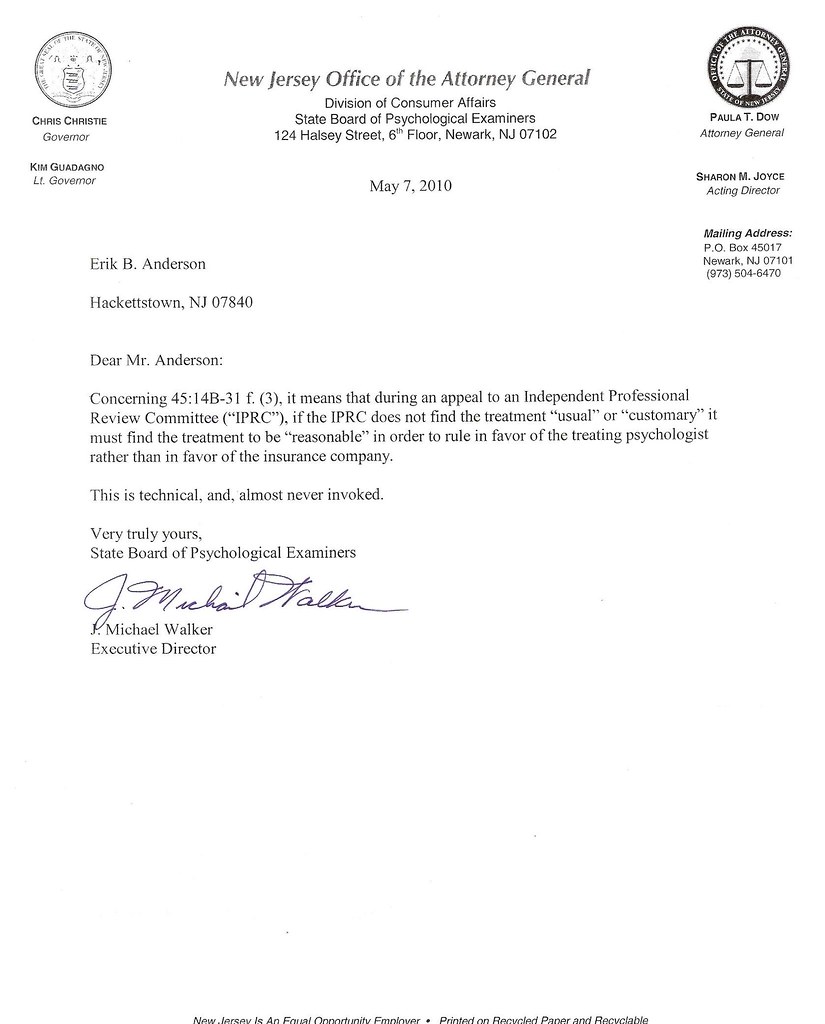
A Technical and Almost Never Invoked Rule

Last month, I wrote to the NJ State Board of Psychological Examiners because I found something strange when I read their Laws out loud.

The way I read it, if a person is allowed to practice psychology under the authority of a license given to them by the State of New Jersey, their treatment of patients must be "usual, customary and reasonable", but law 45:14B-31 states:

In applying the standards of "usual, customary, and reasonable," the following guidelines are applicable: If a psychological treatment is "usual" or "customary," an inference that the treatment is also "reasonable" is warranted. If the treatment is neither "usual" nor "customary," then it shall satisfy the criterion of "reasonable."
This law confuses me. I am afraid that it is a permissive statute, allowing psychologists whose practice is unreasonable a get out of jail free card. If I complain to the State Board of Psychological Examiners about my doctors' unreasonable treatment of me - like for example, when a doctor insists that I take psychiatric medication but adamantly refuses to tell me why, and then becomes abusive and insulting when I refuse to put something in my mouth against my will - then this law will let him get away with it.

I got a letter back from the Executive Director of the State Board of Psychological Examiners the other day. I think it means my fears are confirmed:

I wrote another letter to J. Michael Walker asking what the purpose of this law is. I also spoke to Ed Smith, State Senator Michael Doherty's Chief of Staff. He could not tell me the purpose of it. In fact, he agreed with me that Psychologists have a lot of power and this kind of thing should be carefully examined. My state Assemblymen are both aware of the situation as well.

This matter is not resolved. I will report back when J. Michael Walker writes back to me.

In the meantime, ask yourself: What is the purpose of this law?

Warm Regards,

Erik B. Anderson

Friday, May 7, 2010

My Therapists' Office

So I'm walking along Macculoch Avenue in Morristown this afternoon and this guy trying to sell me a historic walking tour points across the street and says: "That's Thomas Nast's house! He was the cartoonist who created the democratic donkey and the republican eleph-" I said, "Yeah, yeah, I know who he is." He created Uncle Sam and made Santa Claus jolly image famous.He brought down the Tweed ring, and the Nast in Conde-Nast Publishing (i.e. The New Yorker, Harpers Magazine, Atlantic Monthly I think, etc.) is named after him. And do you know what house this guy was pointing at?

My first therapists' office. That made my day.

What kids need these days is a sense of place, a sense of belonging.

Not medication. Not mandatory therapy.

Warm Regards,

Erik B. Anderson
Independence Township, New Jersey

Check out The Nast Collection at Macculloch Hall Historical Museum!

Thursday, April 29, 2010

Does this look right to you?

Could there be a typo in the NJ State Board of Psychological Examiners Laws?


45:14B-1. Short title
This act shall be known and may be cited as the "Practicing Psychology Licensing Act."
L.1966, c. 282, s. 1.

...

45:14B-31. Definitions

As used in this act:

a. "Administrative information" means a patient's name, age, sex, address, educational status, identifying number, date of onset of difficulty, date of initial consultation, dates and character of sessions (individual or group), and fees;

b. "Diagnostic information" means therapeutic characterizations which are of the types that are found in the Diagnostic and Statistical Manual of Mental Disorders (DSM III), of the American Psychiatric Association, or other professionally recognized diagnostic manual;

c. "Disclose" means to communicate any information in any form;

d. "Independent professional review committee" means that group of licensed psychologists established pursuant to section 14 of this act by the State Board of Psychological Examiners;

e. "Third-party payor" means any provider of benefits for psychological services, including but not limited to insurance carriers and employers, whether on an indemnity, reimbursement, service or prepaid basis, but excluding

governmental agencies;

f. "Usual, customary or reasonable." In applying this standard the following definitions are applicable:

(1) "Usual" means a practice in keeping with the particular psychologist's general mode of operation;

(2) "Customary" means that range of usual practices provided by psychologists of similar education, experience, and orientation within a similar geographic or socioeconomic area;

(3) "Reasonable" means that there is an acceptable probability that the patient will realize a significant benefit from the continuation of the psychological treatment.

In applying the standards of "usual, customary, and reasonable," the following guidelines are applicable: If a psychological treatment is "usual" or "customary," an inference that the treatment is also "reasonable" is warranted. If the treatment is neither "usual" nor "customary," then it shall satisfy the criterion of "reasonable."

L. 1985, c. 256, s. 1.

Read it out loud. At the risk of sounding crazy, I want to say publicly that I think you'll agree with me that the last sentence of 45:14B-31 f. (3) should read:

"If the treatment is neither "usual" nor "customary," then it shall not satisfy the criterion of "reasonable."


Source: State Board of Psychological Examiners Laws - PDF file - posted 1/8/09 page 7-8

Friday, November 20, 2009

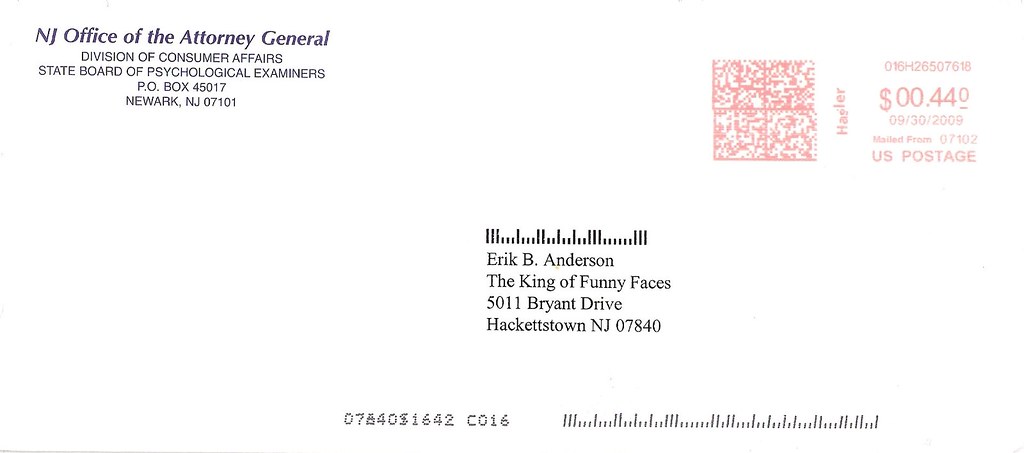
Write to the King of Funny Faces

There are two addresses here:

The NJ State Board of Psychological Examiners Has a Sense of Humor

Hate mail goes to the address on the left. No bullets, please.

Fan mail goes to the one in the middle.

Warm Regards,

Erik B. Anderson
The King of Funny Faces
Independence Township, New Jersey
Established 1782